
72 Hare

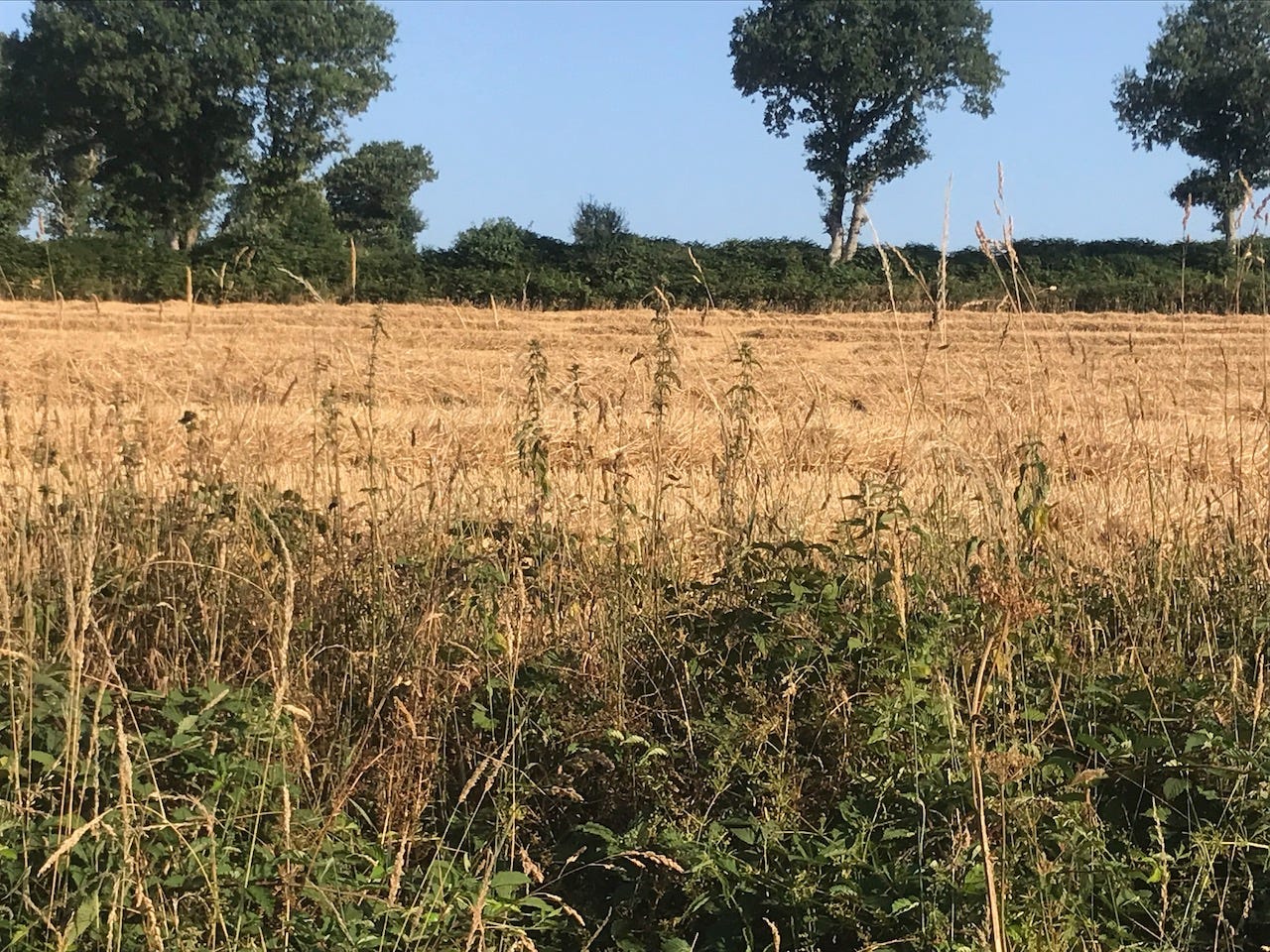
… This photo of a cut cornfield, barley lifted, straw laid down in windrows, has no hares in it, as you might notice. Shortly before, however, I had the privilege of seeing three enormous hares leaping away from the lane towards the far hedge: a joy on many counts.
It was a golden dusk and a golden field; even the hares seemed gilded. We occasionally see just one here; that there were three, and that none of them had been mangled by the combine harvester or hunted – it’s always open season on hares – in such light made these iconic animals even more magical than they always seem.
And they were huge – no chance of mistaking them for rabbits, though I did initially wonder if they were young roe deer; yes, that enormous.
Although they need a diversity of plants to eat, cornfields give them some protection from predators. I don’t know if ‘my’ trio were eating the barley gleanings, or adjusting to the fact that their cornfield had been cut down overnight.
Hares are in decline here and very much so in the UK where many are still hunted. I grew up in deeply rural North Devon, but I never saw a single hare, despite spending most of my young life outdoors and with very-nature-aware parents. (I blame a hamlet not very many miles away called ‘Harepie’.)
The first I saw was in my 40s, near Painswick in Gloucestershire. Then, when I moved in with TM near Totnes in South Devon we saw them occasionally: they seemed to haunt a particular crossroads near us, and we did see them in adjacent fields. Once, a hare raced into our courtyard in front of the house feet from where I was sitting, circled it, and raced out again.
If you live in southern England I believe they’re a whole lot more common, though there are still organised hare hunts.
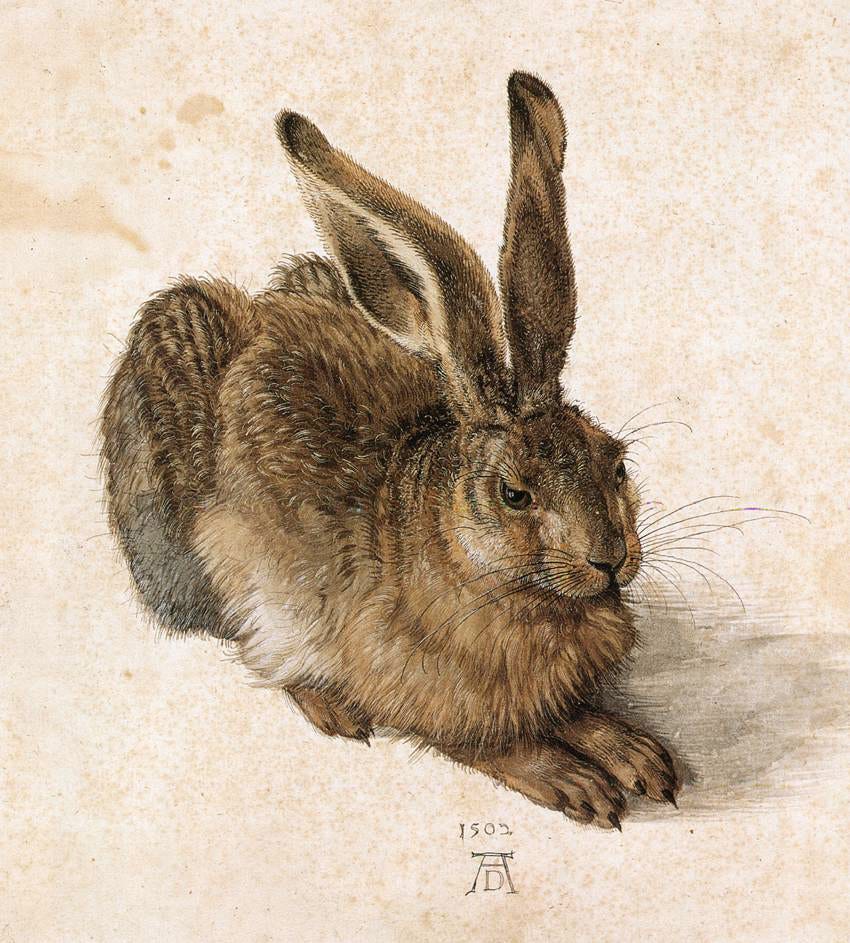
These elusive mysterious creatures are magical. It’s hard to imagine how anyone could see them without a shiver, let alone foist brutality on them (though that of course also goes for all the intensively-farmed animals, especially young ones like veal calves).
Hares are, in a way, homeless. Is this one of the reasons we see them as elusive? They nest, usually briefly, in a form, a dip or divot, in the ground; it’s not a home in the way a burrow, or an earth, or a sett is a home. This makes them, and their offspring, particularly vulnerable.
Symbolically hares represent intuition, transformation and the numinous – as if they belong neither to the physical earth nor entirely to the Otherworld, though in shamanic thought they offer access to the latter. Associated with the moon, the feminine principle, Easter/Oestre/Eostre and the Goddess, in the Middle Ages it was widely believed in the British Isles at least that witches could shapeshift into their familiars, the hare; hares were therefore demonised and routinely hunted down. (Graham Joyce in his book The Limits of Enchantment has a haunting story about such persecution.)
This fleet-foot animal – they can reach speeds of up to 45mph – has a noticeable quality of energy not dissimilar to the seal, though of course in a very different ‘medium’. Both seem to emanate feminine energy.
There are many stories about hares. In a Cornish fishing village, for instance, a white hare was said to appear when storms were on their way, and the fishermen knew to cancel going to sea when this appeared.
There’s the story of 7th century Saint Melangell, a hermit nun in North Wales, who protected a hare from the prince’s hunt on the land on which she’d established her hermitage. Perhaps he appreciated her offering of refuge to the hare, despite his hunt being spoiled, as he then magnanimously gave her a tranche of the royal land on which she was living. Her chapel there is now seen as a sanctuary and a site of pilgrimage. A version of the story can be seen here.
Then there is the Three Hares motif. Acquaintances of mine from Dartmoor tracked down more than 20 examples of this motif, usually in church windows, in Devon. Often it accompanied a Green Man icon. Who knows where and when this originated (it’s found as a motif in many other parts of the world), and what its symbolic meaning is? Some associate it, in churches particularly, of course, with the Christian Trinity. Perhaps it’s an older motif, maybe from pagan times, representing the Triple Goddess as Maiden, Mother and Crone.
As one of the druidic ‘sacred animals’, you can call on the hare as symbol of intuition and the Otherworld if you have lost sight of what is elusive and magical in life/your life; if you need inspiration or transformation; if you find yourself bogged down in the mundane, ordinary and commonsensical aspects of living.
And if you need a good book to read, and haven’t yet read it, I urge you to find Chloë Dalton’s book Raising Hare: so inspiring that I re-read it as soon as I finished it.
Thank you for reading, my friends. After such scorching sun in which I’ve lived like a troglodyte behind curtains, immobilised by and unmotivated in the extreme heat, sponging the hairy dog down every little while, we’ve had tremendous thunderous storms, and tempestuous if too-brief downpours. You could see the plants stretching up to the rain, and the lanes are full of goldfinches and chaffinches scavenging hedge and tree seeds, and perhaps barley gleanings too. If I go quiet again, you’ll know that the sun is back in its high 30s or even low 40s. I hope that it’s gentler where you are.
As always, I’d love a ‘like’ or a comment or a share, if you’re so inclined.
Thank that was sweet and informing, and I too loved Raising Hare.
Catherine
I’m so happy that you mentioned Chloe Dalton! Raising Hare is magnificent and magical.🩵